Cameras, Part 1
Digital, mirrorless photography
I mentioned in a post from a couple of years ago that I had gotten into photography. I feel like I should probably write more about that. So this will be the first of two posts about my cameras and photography. This one will focus on the digital side, the next on film.
Why?
My first experience with an interchangeable-lens camera was with a Nikon D3500 that my dad bought around when I graduated from college. He had no clue how to use it, so most of my graduation pictures are out of focus, but it’s a solid entry-level DSLR and I’ve used it plenty (at various races, mostly).
Separately, COVID hit and I started going for more walks around the neighborhood and parks with my daughter in the stroller. Then she got bigger and wanted to walk on her own, then didn’t want to walk at all and refused to ride in the stroller, and those walks kind of stopped.
After a while, I decided I wanted a camera. It would be a fun hobby and would motivate me to get out of the house more.
Canon M200
I first bought a Canon M200. It was an entry-level mirrorless camera that was on its way out when I bought it (around 2022). I should have done some more research, but at the time it was a pick on DPReview’s “Best Cameras Under $500” list. I should have noticed at the time that the list was pretty stale, but I picked one up anyway.
It’s a nice camera, and for a few reasons I kind of wish I had one, but as a secondary shooter and not my primary camera. It takes great pictures, and when paired with the EF-M 22mm f/2, it’s a monster in a tiny package. But I quickly found out what I wanted most in a camera: an EVF.
So I sold the M200 and bought another camera, a used one so in the end I barely spent any money upgrading.
Canon M50 Mark II
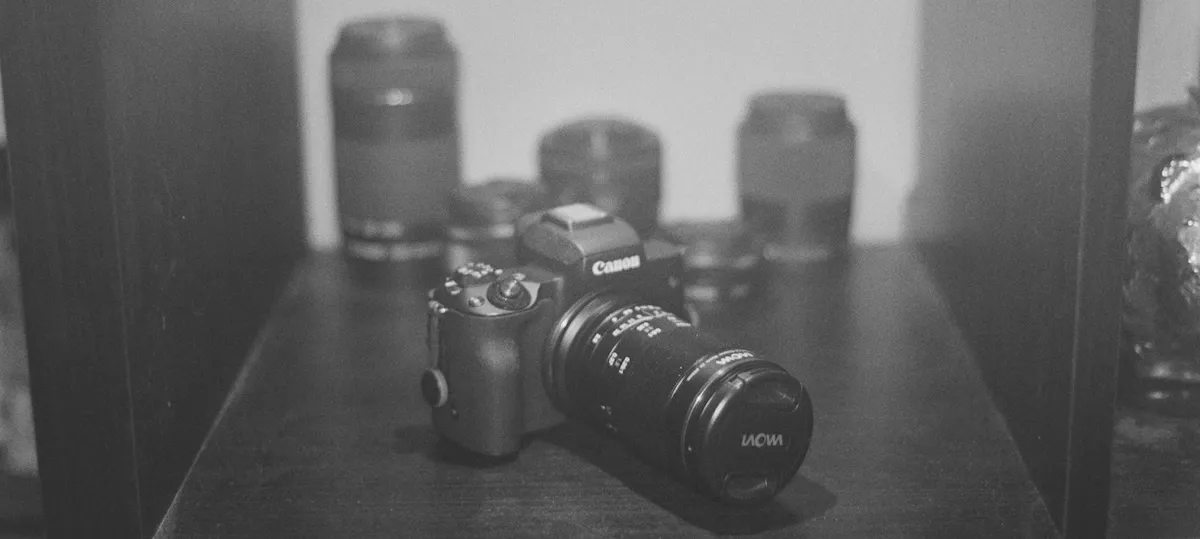
The M50 is basically the M200 but with an EVF. It’s wonderful, but again I should have read the room better.
Around when these cameras came out, there was a divide between DSLRs and mirrorless cameras. Micro Four Thirds dominated mirrorless space, so mirrorless cameras were seen as the small, portable alternative to DSLRs. This was the environment where Canon introduces the EF-M mount and it was designed only for APS-C sized sensors. But right after this, other companies (Sony) started putting full-frame sensors in mirrorless cameras, and then Canon was stuck. Rather than trying to bodge full-frame support into EF-M, they introduced the RF mount and the days were numbered for EF-M.
None of this means the M200 or M50 were bad cameras or that they would not stop working, it just meant that they wouldn’t get new features or new lenses. Again, not exactly a problem, but it limits where I can go with this body. I have a set of lenses that I won’t be able to carry forward to any new camera, and that sucks.
Though the lenses are pretty nice. Here’s what I have:
- Canon EF-M 15-45mm f/3.5-6.3 IS STM - the kit standard zoom lens that came with the camera. Not super sharp, not very fast, but compact and versatile.
- Canon EF-S 55–250mm f/4–5.6 IS STM - a DSLR kit telephoto zoom lens that I use an adapter with. Quite large on the camera, but surprisingly sharp and with very long reach (about 400mm equivalent on the long end).
- Canon EF-M 22mm f/2 STM - a pancake prime with a standard wide focal length (35mm equivalent). It’s tiny and fast. For portability, it’s the best.
- Sigma 30mm F1.4 DC DN Contemporary - a normal (50mm equivalent) prime lens. Incredibly fast and sharp, but a little bulky.
- Canon EF 50mm f/1.8 STM - the super cheap, very good “nifty-fifty” prime lens. Except, since it’s being used on a crop sensor (with the same adapter from the telephoto zoom lens) it’s actually a short telephoto lens.
- Venus Optics Laowa 65mm f/2.8 Ultra Macro APO - my current favorite lens: the macro. It’s fast, sharp, and can focus stupidly close. It’s also fully manual, which is still a bit of a challenge to use, but gave me plenty of prep for the film cameras.
The camera is nice, though I wish it were better. The lenses are nice, though I probably won’t ever buy any more of them. Someday I’ll probably move on and basically have to start the whole system over, but for now and for a while longer, I have a great camera to shoot with.
Post Processing
I have found that editing photos is the worst part of the whole photographic process. I like the physicality of going out to shoot. I like using all of the buttons on the camera, the knobs and dials and lens rings, to set up the shot just right. But after I get the shot, I don’t really want to edit it. I do, but I try to keep the process simple. Crop and straighten (because I can never take a level photo), then adjust a few levels. Maybe convert to black and white. Maybe use some masks to highlight the subject, de-emphasize the background.
I should probably mention the software I use/used. I started with Photomator. It’s a very competent editor and I could do most of my library management in Apple Photos. It served me well for several years. But it had one major shortcoming and that was limited lens corrections. See, that Sigma 30mm lens has some intense barrel distortion and Photomator just couldn’t do anything about it. So I decided to give Lightroom a try. Sure, it’s expensive, but there’s a reason it’s the standard. I did start with Lightroom Classic, but I found it too clunky and I wanted the option to edit on my iPad sometimes, so I migrated to Lightroom (non-classic? modern? suffix-less?) and I’ve been happy with it (despite the price).
What Am I Shooting?
I mentioned in the previous post that I found 52Frames and I’m still keeping up with it. I’ve only missed one photo since I started it (simply because I forgot to upload, ugh). It’s fun having a new challenge each week and is a great motivator to get out and try something new. You can find my profile here, and I also post to my Pixelfed account.
Next Up: Film
It’s kind of obvious where this goes next, huh?